
First Things
Calendars change, solutions don’t.


Annus horribilis. Queen Elizabeth II, rest her fascinating soul, put that bit of deliciously pretentious Latin on the map a bit over three decades ago. At the time she was speaking of 1992, which she considered an absolute bellend and total slog (as far as slogs go for extraordinarily wealthy white monarchs for whom “summer” and “winter” are verbs).
It’s a phrase I’d not hesitate to apply to 2025 CE, a truly horrible year.
For over well over 300 rotations, that annus horribilis seemed pointedly desperate to remind every living thing on the planet that 49.8% of the active American electorate — about 0.93% of the global population — had gotten together one day and voted to Break The World.
Perhaps that’s a big part of why it feels strange to hear the swaddled infant New Year, mewling and puking in the nurse’s arms, screaming “Hey, wait a sec, hold my beer!”
In case you haven’t noticed (and that’s a real damn problem — the number of Americans who haven’t noticed, that is), in just over a fortnight we’ve achieved altogether fresh levels of chaotic evil.
If you’d have told me in 2025 that its successor would begin here…
…in a week that featured the ICE-in-reverse kidnapping of a Venezuelan head-of-state…
…proceeded to include our makeup-caked Praefectus horribilis buffing the varnish on American Empire with naked expressions of malignant, under-repressed will to power…
…and ended not only with the useless slaughter of Renee Good, a Minnesota mom murdered in her minivan, but with grotesque new depths of Orwellian newspeak unleashed by the Trump regime to sanctify it’s splashiest come see the violence inherent in the system-moment yet…
…well, I may have said something tasteless and glib about inevitability, waving off any pretense at shock or surprise.
Sounds on-brand, perhaps.
Throw in a dash of threatening war with Europe, erasing NATO and with it the last vestiges of the Pax Americana, effectively giving Xi Jinping and Vladimir Putin the single greatest Spa Day ever, because… <checks notes> oh you have got to be kidding me… because Greenland?!? Totes bonkers.1
How ‘bout a pinch of threatening what remains of the global economic order by challenging the independence of the Federal Reserve via risible pseudo-legal claims bubbling up from a fully-captured Justice Department eager to provide a happy ending to the Oval Office? How’s that work for ya, Mr. Politics-Knower?
It was always a question of when, not if, y’know…
Okay. Let’s throw all that in the stand mixer (paddle attachment) with the chemical rounds and tear gas wafting through elementary school pick-up lines in Minneapolis. Blend until smooth.
Carefully fold in thousands of images — about 6,600 per hour — of revenge porn and naked children being made-to-order by Grok, the chatbot at the root of X/Twitter, the social media platform and “deepfake factory” captained by full-time white supremacist and part-time World’s Richest Humanoid, Elon Musk.
Garnish with garden-fresh threats to invoke the Insurrection Act of 1807, a two-century-old legislative Hail-Mary which “provides a statutory exception to the Posse Comitatus Act”. That is to say, it sets aside the rule against using the nation’s armed forces as domestic police, willfully aiming the might of the American military — the biggest gun in the history of the known universe — at the People of the United States.
Wouldn’t surprise me. Bombs, boobs, billionaires, and big ol’ bazookas. That’s MAGA for ya.
Real C-/D+ stuff from the fortune-teller that is this wholly-fictional, completely imaginary 2025 Milo Baynes. Don’t @ (the real) me.
But it does surprise me.
It’s far too surprising. For all that lazy predictability and cheaply-bought expectedness, if you’re like me (and on this occasion I honestly pray you’re not), you have found yourself unexpectedly brutalized by, well, all the darned brutality. You’ve discovered that the bellicosity of this pre-reckoned, multi-pronged assault is making war on you, in you — the grizzled veteran you — a jaded, worldly and wisdom-worn Cassandra who, after all, knew this was coming.
Next thing you know your stoic acceptance of the inevitable is nowhere to be found. You’ve been slapped silly by all that your brain refuses to accept. It’s not alone, your brain; when invited to sit with the same stuff, even your body resists. You sob, you vibrate. You breath wrong. Too little, too much, erratically.
Yep, you’ve been dropkicked like a squooshy-red gym-ball, straight into the infinite chasm between what was inevitable and what cannot, will not, be made to make sense.
That chasm goes by many names: aporia, incommensurability, the uncanny, the Sublime. A word-geek’s dream, every one of ‘em. Dive into their Greek, German, or Latin forebears or scan their use by philosophers and theorists and what you’ll discover that is that each developed as a more-or-less fancypants way of saying “things here don’t work like they do at your house”.
Or, “huh, this is weird but — somehow — this stuff you have here…yeah, well, it does not present itself in, ummm, a form for which we have measurements”.
At their simplest? “You can’t get there from here”.
What to do. What to do. What to do.
In the face of senselessness and disorientation, what to do? When the path ahead is so darkened and obscured that it feels as if the ground has disappeared beneath your feet? What to do when you don’t recognize the landscape, see no signposts or recognizable landmarks — when you’ve a feeling, Toto, that you aren’t in Kansas anymore?
My cousin is a nurse and a mom and a hilarious snark. She’s not quite 40, recently divorced, with 3 wonderful kids and the ability to instantly drop into a hillbilly drawl that’ll totally slay you. She also tends to live her life away from “the news” but has has recently found herself unmoored by 2026. “I don’t know what to do…”
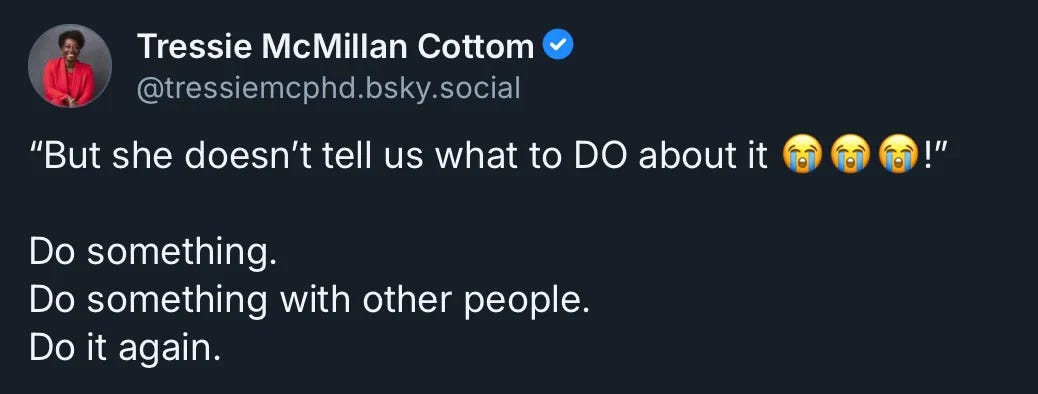
There’s only the one good answer. It’s all the answer there has ever been and all there will be.
We’ve covered it here before. It’s the answer of the courageous people of Minneapolis. It’s the answer of immigrant communities. It’s the answer of the families forced to suffer as prey to the hunger of a decidedly white nationalist regime that, each day, further stains the national fabric with the sin of ethnic cleansing. It’s the answer of Renee Good, a woman who, after dropping her child at daycare, happened upon something ugly and thought she ought to do something.
Do something. Some thing. It doesn’t have to be putting your body, your life, your world between an agent of hate and his victim (though it can be, if that’s where you’re at and the arithmetic works). Begin by doing x — where that x starts with any-thing besides no-thing — anything besides going about one’s business as if not a thing was out of place, as if everything was functioning to spec. That may be protesting. It may be volunteering, giving resources or time to a cause or concern which calls to you. (Your county Democratic Party, for example, would be thrilled to have some help. Same with Indivisible. And local food banks. And shelters. And…)
Doing something may even be just sharing what you’re seeing and what you’re feeling with your friends, or talking to neighbors and family, particularly those who may be unengaged or unaware, about what is happening. Bearing witness to the realities in your community, town, state, and nation can be a some-thing, especially if it is a thing that exceeds what you were doing before, what you’d be doing otherwise. What legal observers in Minneapolis and ICE watch groups around the country are doing is bearing witness, albeit with a heap of added forethought, organization and training.
Do something with others. There’s all sorts of reasons for doing things with other people (the list is nigh on inexhaustible). For starters, that “forethought, organization and training” we were just talking about is a prime benefit of making your group-work game a little tighter. There are experts out there, people who have a solid resume of doing something and doing it with others. They have heaps of experience to impart.
Doing things with others changes your perspective on what is possible and can lift you (all) up, wake you (all) up, keep you (all) up and going, give you (all) strength. Such is the way with plurality, no matter if that plurality says youse, yinz, you guys or the always proper y’all.
The second person plural is also where power begins, as noted way back in the very first of these chats here at The Holler.
For now (not to sound too ominous), Americans can only acquire institutional power in the usual, proper, time-honored fashion: through the machinery of democracy (y’know, because the other ways are violent or damnable). We vote, we run for office, we get involved, we communicate, we build coalitions, and we convince people — quite often one at a time (and sometimes by knocking on their door or writing them a postcard) — to join the rest of us in the political magnum opus, that Great Work which is nothing less than the multi-generational project of bending the moral arc of the universe. The only one of the above things that can be done alone is the first one: voting. Voting is the only solo political act. Period. Everything else about the process of acquiring, developing, and deploying political power is a group sport, a communicative, communal activity.
Call me a utopian or idealist but it seems to me that every timeless motivation, every path to to every great and worthwhile goal — Changing the World™ or Making Things Better®, and the 57 varieties of leaving this place better than you found it, etc — runs directly through that glory-bound little apostrophe (or “God’s comma”) which connects you and all to make y’all. This is the faith and the practice of pluralism and popular governance and it is precisely what autocrats, authoritarians, and all manner of asshats are aligned against.
Do it again. Yeah, sorry, but it’s true: after lather and rinse almost always comes the dreaded repeat.
If your goal is very, very specific — like fixing a pothole, that pothole right there — you could, possibly, get in and out of social action without this step. Unfortunately, very few will know such simple joy and innocence. This is often the toughest part of the recipe. It chafes, grates, and otherwise goes against the character of American practicality and problem-solving to reckon that some problems resist — and will always resist — being fixed, once and for all, and becoming forgettable.2
No, if you’re bothered by the state of the nation in 2026, you’ll either be gladdened or saddened to hear that a great many of the things you’re bothered by were also bothersome to the Americans of 1776. From the nation’s get-go, demagoguery, lust for power, corruption, abuse of authority, greed and a host of other flaws and sins were heavy on the minds of our predecessors. Need proof? Check out the list of complaints leveled against the English crown in the Declaration of Independence and see if you notice any modern parallels. Or consider the efforts put forward by the Constitution’s framers to ensure that opposition and contest would exist both within and between the branches of government in the hope that making us “repeatedly do things with others” might serve to keep in check a vast menu of human moral failings.
To a degree, some lack of rest and respite is written into the DNA of the nation. And, it is core to my belief structure that this is so because, to some degree, some lack of rest and respite is written into what it means to be human and social and alive. I understand exactly why that puts so many people off and underscores a great deal of what we call political apathy. It is a tough realization to surmount, that you might fight and struggle, strategize and organize, accept all the anxiety and discomfort (even danger) of bettering the world — with no guarantee that the world bettered will be yours. That’s some nasty-tastin’ medicine.
A few paragraphs back you may have noticed the phrase “the moral arc of the universe”. The whole phrase — “the arc of the moral universe is long, but it bends toward justice” — is an image born in the abolitionist movement and popularized to immense effect by Martin Luther King, Jr. I think about it often. I suspect lots of folks do. To some people it offers comfort, as a promise that, one day, things will inevitably improve.
Me? I reckon there is a moral arc to the universe, but I’m much less certain about which way it may or may not bend when left to its own devices. What’s more, I’m pretty confident that sitting around and waiting for some big ol’ four-dimensional cosmic arc to get up off the couch and bend itself is likely one of those “Roads to Hell” you often hear about (the ones paved with good intentions instead of proper, paving-grade road asphalt , which surely would make for a much nicer, longer-lasting road).
The promise of a moral universe — one determined by justice, one oriented toward fairness, plenitude, fellowship and community — that is a promise which requires lots of benders doing lots of bending. It calls for doing something, not just when it is easy, not just when victory is just around the corner and the promise of justice is within reach, but all the time, over and over again. That realization can feel stifling and petrifying or it can be freeing and celebratory — as in, we can bend it, we get to bend it. And we don’t have to ask for permission — we can just do something. We get to make a difference, and bend the moral arc of the universe, with each action to make people’s lives more prosperous and not just more profitable.
Every time we choose the common good over one individual’s gain.
Every time we can ease some suffering, great or slight.
Every time we choose that which is nice over that which is nasty, that which is kind rather than easy, quiet or quick…
…and every time we choose to do so even though we may not unrig the system tomorrow or the next day or the next.
Yes, it may be the case that — as the opposition or resistance, as “leftists” or “liberals, as Americans committed to justice and compassion and kindness and the common good — we may have seasons ahead of us defined less by victorious once-and-for-all problem fixing than by reassessment, rebuilding, re-engagement and renewal.
But we know what is required.
Lots of benders doing lots of bending.
Happy New Year!
I’m Milo Baynes. Thanks for trusting me with your time.
@milobaynes.bsky.social
Specifically because owning Greenland feels more psychologically satisfying than renting, according to the President of the United States.
I often think of a phrase from the Obama years that never failed to astound me: “post-racial America”. That one’s an absolute stunner. Often said by white folks who thought a black President had erased…well, everything, something, anything at all. I find it hard to believe that anyone who successfully puts on their own socks could believe such a thing had come, much less say the words aloud — as if any actual and existing early-21st century reality might have grounded such a stupefying signifier (even less so, a reality that could be invoked by voting it into being). Sigh. We are often the silliest of all possible monkeys.
Thank you for being an idealist. Your words make going on possible.
"Lots of benders doing lots of bending." Everyone doing something, anything, to bend that arc towards justice. This was such a convicting and encouraging read, Milo. Thank you for sharing.